Tiny House Prices in Europe: How Much Does a 20 m² or 30 m² Tiny House Cost in 2026?
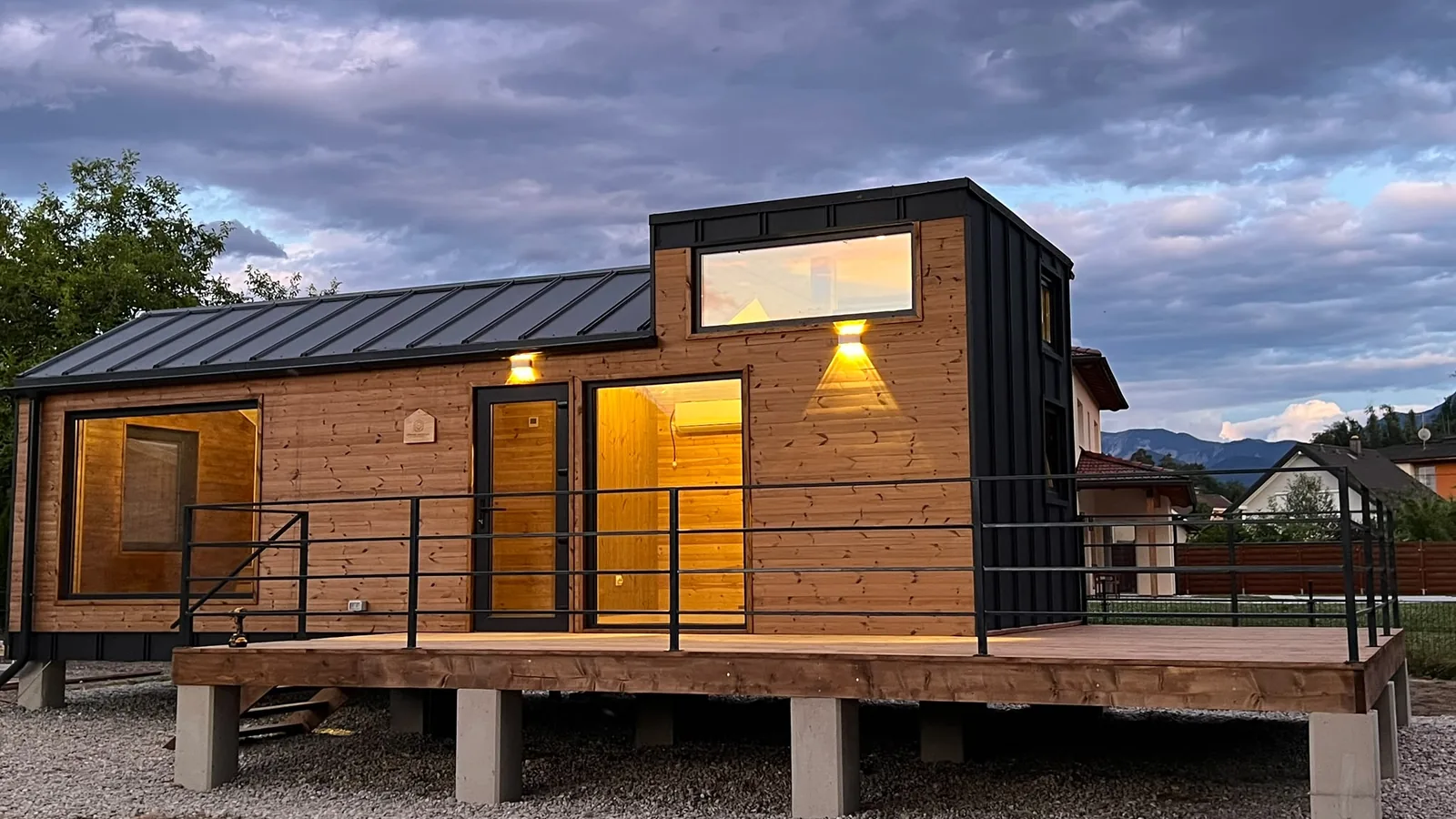
Kubo Loft delivered and installed in Rosseg, Austria — one of the projects in our portfolio.
The popularity of compact homes has grown sharply in recent years, but the main question for most buyers stays the same: how much does a tiny house actually cost? The answer is less simple than it looks — the same home can cost four times more depending on where it is built.
Tiny house prices vary considerably from one European country to another. A compact home that costs around €22,000–€32,000 in Romania can reach €60,000–€90,000 in Germany, Denmark or the Netherlands, and may exceed €100,000 in Switzerland.
To make the comparison meaningful rather than anecdotal, this analysis focuses on two representative sizes: tiny houses of approximately 20 m² and tiny houses of approximately 30 m². The purpose is not to compare specific brands or models, but to estimate an average tiny house price per square metre in each European market included in the study.
How the Average Tiny House Price Was Calculated
Comparing tiny house prices is harder than it first appears. Some offers include only the structural shell, while others include the bathroom, kitchen, utilities, furniture and heating system. Two adverts showing the same number can describe very different products.
To avoid misleading comparisons, the analysis focused, wherever possible, on homes that meet all of the following conditions:
- they are fully finished, or delivered at a stage close to turnkey;
- they are properly insulated for year-round use — what we mean by that is covered in our guide to what a four-season tiny house really is;
- they include electrical and plumbing systems;
- they have a bathroom and a kitchen area;
- their floor area is between 18 and 22 m², or between 27 and 33 m²;
- they are new, not second-hand;
- they are not basic kits, garden cabins or unconverted shipping containers.
Land, foundations, planning costs, utility connections and transport have not been included, because these expenses depend far more on the installation site than on the country where the tiny house is manufactured.
Average Tiny House Prices in Europe
Sorted from the most affordable market to the most expensive, the spread across Europe is wider than most buyers expect — roughly a factor of four between the two ends.
| Country | Average price · 20 m² | Average price · 30 m² | Price per m² |
|---|---|---|---|
| Romania | €22,000 | €31,500 | €1,050–1,100 |
| Poland | €33,000 | €45,000 | €1,500–1,650 |
| Spain | €44,000 | €60,000 | €2,000–2,200 |
| Czech Rep. | €47,000 | €76,500 | €2,350–2,550 |
| France | €53,000 | €73,500 | €2,450–2,650 |
| Belgium | €54,000 | €75,000 | €2,500–2,700 |
| Germany | €60,000 | €84,000 | €2,800–3,000 |
| Netherlands | €61,000 | €84,000 | €2,800–3,050 |
| Denmark | €64,000 | €82,500 | €2,750–3,200 |
| Luxembourg* | €66,000 | €90,000 | €3,000–3,300 |
| Switzerland | €88,000 | €123,000 | €4,100–4,400 |
Tiny House Prices Country by Country
Romania
Romania is the most competitive tiny house market among the countries included in this analysis. The estimated average price is approximately €1,100 per m² for a tiny house of around 20 m², and €1,050 per m² for one of around 30 m². That works out at roughly €22,000 for 20 m² and €31,500 for 30 m², excluding land and installation-related expenses.
Cheaper offers exist, but they deserve a close look. A very low advertised tiny house price may not include furniture, heating, sanitary equipment, appliances, or insulation suitable for year-round use. Romania's main advantages are lower production costs, a long tradition of timber construction, and the ability of local manufacturers to export to Western European markets.
For reference, our own entry model — the Kubo Loft Mini, 22.4 m², from €22,046 excl. VAT — sits almost exactly on the Romanian average calculated above, delivered turnkey and insulated for year-round use.
Poland
Poland has a strong industry specialising in mobile homes, timber construction and modular housing. Prices are higher than in Romania but remain competitive against Western Europe: around €1,650 per m² at 20 m² and €1,500 per m² at 30 m², so roughly €33,000 and €45,000 respectively.
The Polish market is highly diverse. Alongside fully finished homes there are many kits and semi-finished units, so the initially advertised tiny house price does not always represent the final cost of a home that is ready to live in.
Spain
In Spain, the estimated average is approximately €2,200 per m² at 20 m² and €2,000 per m² at 30 m² — an estimated budget of around €44,000 and €60,000.
The milder climate may reduce some insulation requirements, but the final price is still driven by finishes, equipment, transport and compliance with local building regulations. Fully autonomous tiny houses fitted with photovoltaic panels, water tanks and independent wastewater treatment can cost significantly more than the market average.
Czech Republic
In the Czech Republic, a tiny house of 20–30 m² is often treated more like a complete modular dwelling than a converted trailer. The estimated average is €2,350 per m² at around 20 m² and €2,550 per m² at around 30 m² — about €47,000 and €76,500 in total.
The higher price per square metre for larger units is explained by the fact that many 30 m² models are built to stricter residential standards and include features intended for permanent living.
France
France is one of the most developed tiny house markets in Europe, with tiny houses on wheels, fixed compact homes and modular garden studios all widely available. For a finished and fully equipped home the estimated average is €2,650 per m² at 20 m² and €2,450 per m² at 30 m² — an indicative price of approximately €53,000 and €73,500.
French offers exist below €40,000 for roughly 20 m², and others exceed €80,000. The gap is driven by the quality of the finishes, customisation, the trailer chassis, autonomy systems, furniture and energy performance.
The 20 m² threshold matters in France from an urban-planning perspective. But the fact that a project may not require a full building permit does not automatically mean a tiny house can be installed anywhere without formalities.
Belgium
In Belgium the estimated average is approximately €2,700 per m² at 20 m² and €2,500 per m² at 30 m², giving total budgets of around €54,000 and €75,000.
The Belgian market is smaller than the French or German ones, and relatively few offers publish the exact floor area, price and level of equipment together. Part of the Belgian supply is imported from France, the Netherlands and Eastern Europe — so the country where a tiny house is sold is not always the country where it was manufactured.
Germany
Germany is one of the most demanding European markets in terms of energy performance and technical construction standards. The estimated average is €3,000 per m² at around 20 m² and €2,800 per m² at around 30 m² — approximately €60,000 and €84,000.
Simpler models can be found for less, but fully finished homes built for permanent residential use and designed to comply with German standards can easily exceed €100,000. In Germany it is essential to distinguish between a mobile tiny house, a holiday home and a permanent residence: the technical and administrative requirements differ, and they move the final price significantly.
Netherlands
The Netherlands has a mature market for compact housing, modular homes and small-scale residential developments. The estimated average is €3,050 per m² at close to 20 m² and €2,800 per m² at around 30 m² — an estimated €61,000 and €84,000.
The relatively high prices reflect labour costs, technical standards, the quality of finishes and strong demand for compact homes. In many cases foundations, transport, site preparation and utility connections are not included in the advertised price.
Denmark
Denmark is one of the most expensive markets in this comparison, but also one of the clearest in terms of turnkey pricing. The estimated average is €3,200 per m² at 20 m² and €2,750 per m² at 30 m² — approximately €64,000 and €82,500.
Note that the price per square metre decreases for larger homes here. The bathroom, kitchen, installations and technical systems are significant fixed costs, and they cost almost as much in a 20 m² tiny house as in a 30 m² one.
Luxembourg
Luxembourg is a particular case. The local market is very small, and the number of tiny houses with publicly available prices is insufficient to calculate a precise statistical average. The market benchmark used here is approximately €3,300 per m² at 20 m² and €3,000 per m² at 30 m², which would put a tiny house at roughly €66,000 and €90,000.
These figures should be read with caution. Many tiny houses available in Luxembourg are manufactured in neighbouring countries, and the final price often includes transport, adaptation and local commercial costs. In future studies Luxembourg may be more accurately described as an installation and consumer market rather than a production market.
Switzerland
Switzerland is the most expensive country in this comparison, at approximately €4,400 per m² at 20 m² and €4,100 per m² at 30 m². The total budget therefore reaches around €88,000 for a 20 m² tiny house and approximately €123,000 for a 30 m² one.
Models manufactured entirely in Switzerland can cost considerably more, especially when they are custom-built, designed for permanent residential use and adapted to alpine climate conditions. Cheaper alternatives exist, but they are frequently kits, imported units, or homes delivered with a lower level of finishing.
Why Can a Small Tiny House Cost More per Square Metre?
At first glance a tiny house should be much cheaper per square metre than a conventional home. In reality, very small homes often have a relatively high price per square metre. The explanation is simple: the most expensive components do not shrink with the floor area.
A 20 m² tiny house still requires a complete bathroom, a kitchen, electrical installations, plumbing, a hot-water system, heating, an electrical distribution board, windows and doors, ventilation, and transport and handling. A 30 m² home does not need two bathrooms or two kitchens — the same fixed costs are simply spread over a larger floor area.
Comparing tiny houses on €/m² alone is not enough. Total price, floor area and level of equipment have to be read together.
What Is Usually Not Included in the Tiny House Price?
Before comparing two offers, check whether the advertised price includes:
- VAT;
- transport;
- crane and installation;
- foundations or ground screws;
- water, sewerage and electricity connections;
- furniture;
- kitchen units and appliances;
- heating;
- a terrace;
- technical documentation;
- planning permission;
- design and engineering costs;
- off-grid systems for plots without utilities.
A tiny house advertised at €30,000 may reach an installed cost of €40,000–€50,000, while a €40,000 offer that already includes furniture and equipment may actually deliver better value.
Which Is the Cheapest Country for Buying a Tiny House?
According to the data analysed, Romania has the lowest average tiny house price per square metre among the countries in this comparison. Measured against Romania, the estimated average is:
- approximately 40–50% higher in Poland;
- almost twice as high in Spain;
- more than twice as high in France and Belgium;
- around three times higher in Germany, Denmark and the Netherlands;
- almost four times higher in Switzerland.
This price advantage does not automatically mean that every tiny house manufactured in Romania is equivalent to one built in Germany or Switzerland. The quality of the materials, insulation thickness, windows, technical systems, certifications and warranty have to be evaluated individually. Nevertheless, manufacturing in Eastern Europe can offer an excellent balance between price, quality and level of equipment.
Conclusion: How Much Does a Tiny House Cost in Europe?
In 2026, the price of a fully finished tiny house varies significantly depending on the country. For approximately 20 m², the indicative budget ranges from €22,000 in Romania to €53,000–€64,000 in France, Germany, the Netherlands and Denmark, and approximately €88,000 in Switzerland. For approximately 30 m², the difference is even greater: €31,500 in Romania, €73,500–€84,000 in the main Western European markets, and approximately €123,000 in Switzerland.
So the answer to "how much does a tiny house cost?" should always start with three factors: floor area, level of equipment, and country of manufacture. What you do with the home matters too — the trade-offs differ depending on whether you are buying for permanent living or holiday rental.
A realistic tiny house price does not represent only the cost of a structure. It represents the cost of a complete, energy-efficient home, adapted to the local climate and ready for its intended use.